A cultural research into the opposite signifiance of this adjectives
Showing posts with label Art. Show all posts

Thursday, January 27, 2011

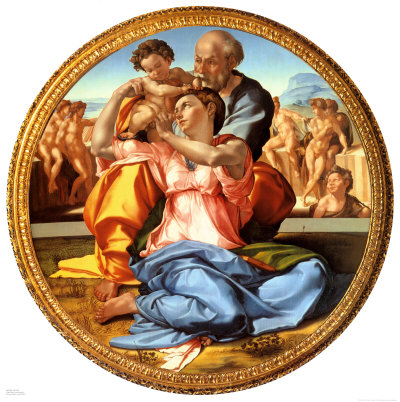
Michelangelo vs Leonardo


Tondo Doni, Michelangelo, 1508

Vergine con il bambino e Sant'Anna, Leonardo

Michelangelo believed that painting should approach the sculpture. His painting technique can be described as statuesque. The subjects of his paintings are well defined and appears impermeables.
Leonardo, instead, thought the painting would approach the reality, and because between one thing and another there is never absolute void, the figures were to fade and lose one another and with the background, so porous.

Wednesday, January 26, 2011

Magritte, La Condition Humaine

In front of a window seen from inside a room, I placed a painting representing exactly that portion of the landscape covered by the painting. Thus, the tree in the picture hid the tree behind it, outside the room.
Renè Magritte, 1933

Then paintings may include both impermeable, because they hide what is behind, that porous, because the concealed portion coincides with the image painted.

La Condition Humaine I (1933)

La Condition Humaine II (1935)
The Promenades of Euclid (1955)
@ Go to the official website of Magritte Foundation

Tuesday, October 26, 2010

Condensation Cube - Hans Haacke

Condenstation Cube, 1963-65

An early exploration of systems and processes, both natural and institutional. In the discourse of institutional critique, the piece may be read as criticism against the closed system of the museum or gallery which attempts to control and contain.


Hans Haacke’s Condensation Cube (1963-65) is a hermetically sealed, clear acrylic plexiglass box, thirty centimeters on the side that holds about one centimeter or so of water. Condensation collects against the inner surface of the plexiglass forming vertical streaks on the inside. How the condensation is created can be explained in the following way: Air can hold only a limited amount of water vapor and when that limit or dew point (a law of nature, which applies to all bodies of air all over the world) is reached, condensation occurs. In almost all art museums, the temperature is set at a cool 65 degrees Fahrenheit, which means that at a relative humidity of about 45 percent (the standard in most museums), the dew point is at 42 degrees. Because plexiglass is a bad thermal insulator, the air temperature inside the Cube is the same as the temperature on the outside, namely 65 degrees. But since the humidity is close to 100 percent, the dew point is much higher, and is, in fact, about 65 degrees, precisely the temperature of the plexiglass.