A cultural research into the opposite signifiance of this adjectives
Showing posts with label Science. Show all posts

Thursday, January 27, 2011

Baggage scanner

Scanned image of a luggage bag
To increase security at airports, all baggage is scanned by X-rays with a procedure similar to that of radiography. So you can also pass through what you cannot see with human eyes only.

@B Learn how Radiography works

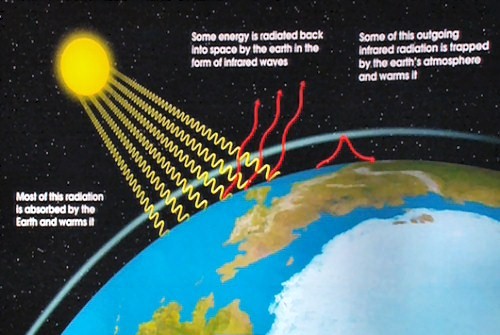
The Greenhouse effect

The greenhouse effect is a process by which thermal radiation from a planetary surface is absorbed by atmospheric greenhouse gases, and is re-radiated in all directions. Since part of this re-radiation is back towards the surface, energy is transferred to the surface and the lower atmosphere. This is because the atmospheric gases, virtually transparent to solar radiation, absorb infrared radiated from the Earth. As a result, the temperature there is higher than it would be if direct heating by solar radiation were the only warming mechanism.
The growing presence of greenhouse gases are endangering the Earth
@ More about Global Warming

Wednesday, January 26, 2011

Hydrate

Cobalt Chloride before and after hydration
Hydrate is a term used in inorganic chemistry and organic chemistry to indicate that a substance contains water. The chemical state of the water varies widely between hydrates.
Mineral hydrates are inorganic salts containing water molecules combined in a definite ratio as an integral part of the crystal that are either bound to a metal center or that have crystallized with the metal complex.
A colorful example is cobalt chloride, which turns from blue to magenta upon hydration, and can therefore be used as a water indicator.

@ Learn more about hydrates

Sunday, January 23, 2011

Lysimeter


A lysimeter is a measuring device which can be used to measure the amount of actual evapotranspiration which is released by plants, usually crops or trees. By recording the amount of precipitation that an area receives and the amount lost through the soil, the amount of water lost to evapotranspiration can be calculated.
The amount of water lost by evapotranspiration can be worked out by calculating the difference between the weight before and after the precipitation input.

@ Visit lysimeter.com