A cultural research into the opposite signifiance of this adjectives

Sunday, February 6, 2011

Dam


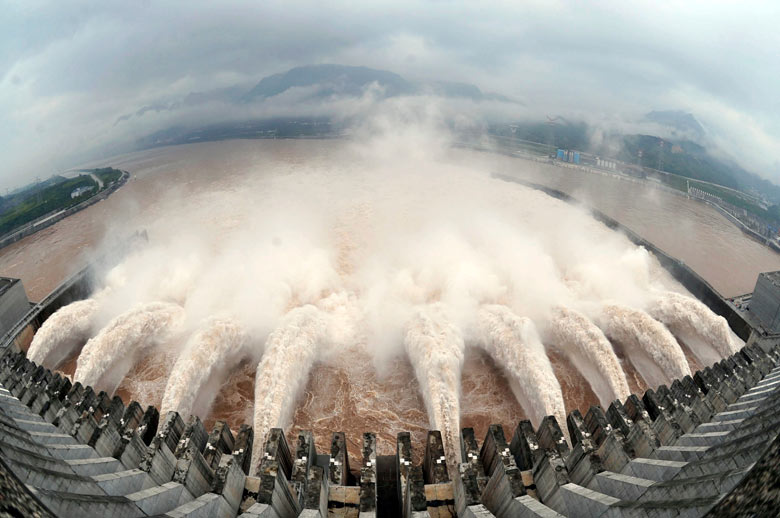
Dams generally serve the primary purpose of retaining water or prevent water flow into specific land regions. But dams are not completely waterproof structures. Hydropower and pumped-storage hydroelectricity are often used in conjunction with dams to provide generate electricity. Infact stored water could be released through turbines to a generator. To boost the power generation capabilities of a dam, the water may be run through a large pipe called a penstock before the turbine.
During an armed conflict, a dam is to be considered as an "installation containing dangerous forces" and shall not be made the object of attack.

@B Do you know Three Gorges Dam?

Plato, Hyperuranium

According to Plato Iperuranio is that area beyond the sky where they reside ideas. So the hyperuranium is that world beyond the sky that has always existed in which the ideas are immutable and perfect, accessible only by the intellect, not visible from land and corruptible bodies. The supercelestial therefore behaves porous compared to the real world, but it is unattainable, and therefore waterproof. Plato speaks about the Hyperuranium in Phaedrus.

@ Learn more about Phaedrus

Atoms vs. Monads

Experiment on atom interaction
For atomists natural world consists of two fundamental principles, atoms and void. Atoms are indestructible and immutable and there are an infinite variety of shapes and sizes. They are the smallest possible division of matter and cannot be split, cut nor in any way further divided, but they interact with each other, in a porous way.

Representation of the Pythagorean monad
The monads are "substantial forms of being", individual, subject to their own laws, un-interacting, and each reflecting the entire universe in a pre-established harmony. Monads are centers of force. Unlike atoms, monads possess no material or spatial character and have a complete mutual independence without interaction, they are impermeable.
Bergson, Closed and open societies

EU Parliament
In open societies, government is responsive and tolerant, and political mechanisms are transparent and flexible. The state keeps no secrets from itself in the public sense; it is a non-authoritarian society in which all are trusted with the knowledge of all.

military blocked the entrance to the Chinese parliament
Closed society claims to certain knowledge and ultimate truth lead to the attempted imposition of one version of reality.

Democracies are examples of the "open society," whereas totalitarian dictatorships, theocracy, and autocratic monarchies are examples of the "closed society."

@ Know more about Henri Bergson

Popper, Open society

Karl Popper, 1945


In open societies, government is responsive and tolerant, and political mechanisms are transparent and flexible. The state keeps no secrets from itself in the public sense; it is a non-authoritarian society in which all are trusted with the knowledge of all, in practice the Society behaves porous.

Political freedoms and human rights are the foundation of an open society.

In Karl Popper's definition, found in his two-volume book The Open Society and Its Enemies, he defines an "open society" as one which ensures that political leaders can be overthrown without the need for bloodshed, as opposed to a "closed society," in which a bloody revolution or coup d'état is needed to change the leaders.

@ Know more about open society

Porous society

The Futility of "Homeland Defense"

"Don't even try to close the holes in a country, and a society, designed to be porous"
David Carr
The Atlantic Magazine, January 2002

@ Read this article

Tuesday, February 1, 2011

The merchant, the donkey and the salt

A merchant who owned a donkey heard that salt was cheaper by the seashore, so he decided to go into the salt business. He went and loaded his donkey with salt and then headed back home. At a certain moment, the donkey accidentally lost his footing and fell straight into a stream. This caused the salt to dissolve, making his load lighter. The donkey was thus able to rise easily to his feet and enjoy a less taxing journey home. The merchant sold what was left of the salt and led the donkey back again to load him with an even greater cargo than before. As the donkey made his way with difficulty back to the stream where he had fallen before, he sank to his knees on purpose this time. Then, after his cargo had dissolved in the water, he leaped nimbly to his feet, delighted to have turned the situation to his advantage, or so he thought. The merchant realized what was happening and decided that the next time he would bring back home a big load of porous sponges. On their way back across the stream, the wicked donkey fell down on purpose as before. This time the sponges grew heavy with water and the cargo expanded. As a result, the donkey had to carry a burden that was twice as heavy as it had been to begin with.

Aesop's Fables
Translation by Laura Gibbons

@ Explore Aesopica fables